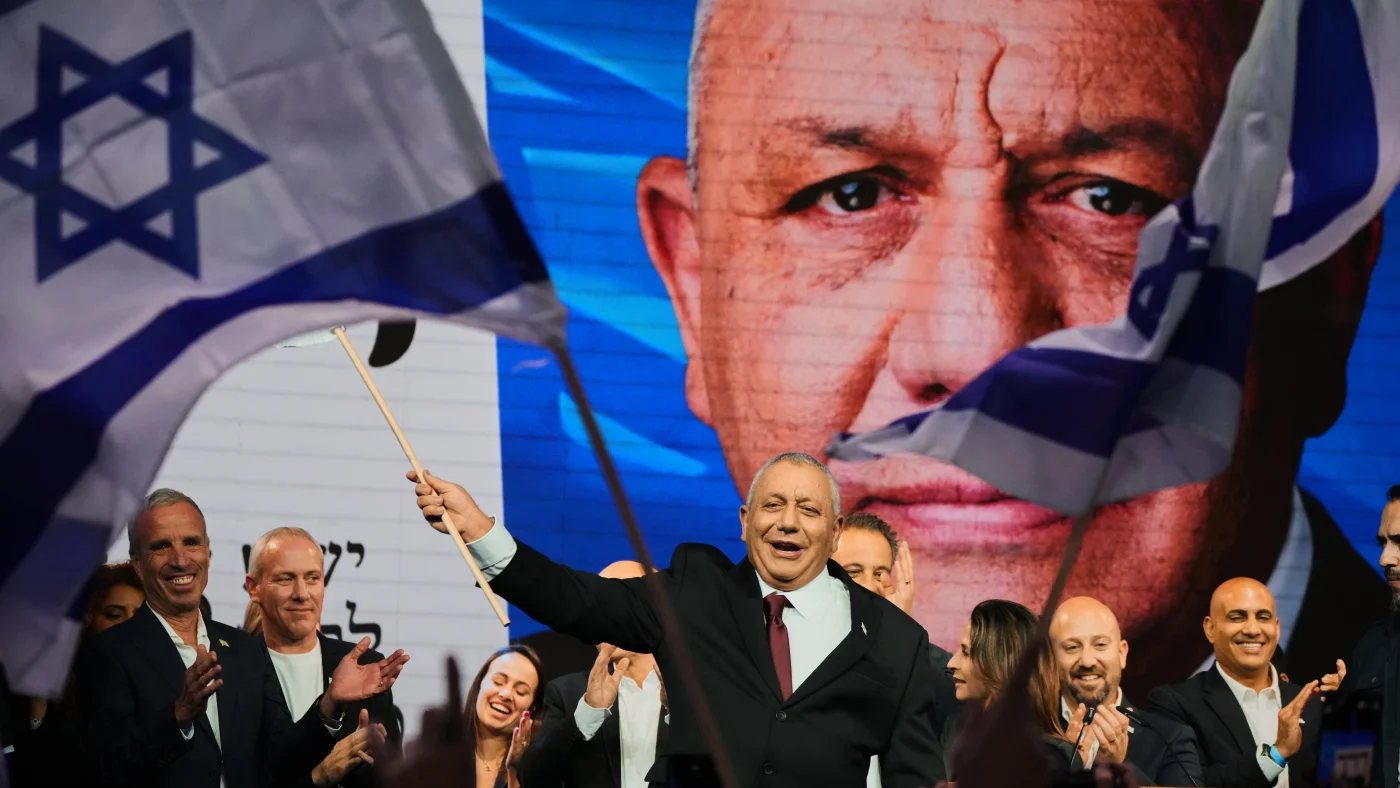
Israel election leaves Netanyahu and Eisenkot blocs short of majority as coalition talks loom
Final results give Netanyahu's right-wing bloc 53 Knesset seats and the opposition 48, with Likud claiming without evidence that Arab-led parties 'stole' the vote.

At a glance
- Netanyahu's right-wing bloc won 53 Knesset seats and Gadi Eisenkot's opposition bloc won 48, both short of a 61-seat majority.
- Likud claims without evidence that Arab-led parties 'stole' the election; the elections committee asked Shin Bet to probe foreign funding.
- President Herzog starts coalition consultations next week; the new Knesset is sworn in Nov. 10 and a stalemate could force another election.
Israel's final election count has left both Prime Minister Benjamin Netanyahu's right-wing bloc and the opposition led by former military chief Gadi Eisenkot short of the 61 seats needed to form a government, opening weeks of coalition bargaining and political uncertainty.
Netanyahu's Likud party and its hard-right allies won 53 seats in the 120-seat Knesset, according to the Central Elections Committee — down from 64 in the 2022 election and below the majority threshold. The main opposition bloc, led by Eisenkot, took 48 seats. Neither alliance has a clear route to a majority.
Coalition arithmetic
Eisenkot's path to power is complicated by the Arab-led parties. The Joint List and Ra'am won a combined 19 seats, an all-time high for Arab-led parties, but most parties in his bloc have rejected relying on them, and Eisenkot has said neither meets his conditions for a partnership.
Netanyahu's party has intensified claims that the Arab-led parties "stole" the election, an allegation that spread after exit polls showed his bloc had suffered a setback. Likud asserted Thursday, without evidence, that foreign interference was "aimed at facilitating a foreign takeover of the Knesset, the Islamization of Israel and toppling of the right wing government."
The statement followed a request from Supreme Court Justice Noam Sohlberg, who chairs the Central Elections Committee, for the Shin Bet security agency to investigate "serious suspicions" of improper influence through funding from foreign entities. Sohlberg said he could not attest to the substance of the suspicions and directed agencies to verify them.
Qatar, accused of trying to mobilize Arab voters, denied interfering and called the allegations "ridiculous and dangerous in equal measure." Opposition leaders also called for a full investigation while warning against using the claims to cast doubt on the results.
Certification and next steps
The count is complete but remains subject to possible "minor corrections" before it is certified and submitted to President Isaac Herzog next Wednesday. The new Knesset is due to be sworn in Nov. 10, and parties have until Nov. 18 to challenge the results.
Herzog will begin consulting the competing parties next week and name the leader he believes has the best chance of forming a majority. Netanyahu may get the first call to start a 28-day coalition process that can be extended by up to 14 days. If that fails, new elections would be called with Netanyahu remaining in office in the interim. Previous government-formation efforts have taken between 20 and 100 days, according to the Israel Democracy Institute. Netanyahu could also push for a national unity government, though many opponents have ruled that out.
A prolonged stalemate could leave Netanyahu in office as caretaker prime minister through another round of negotiations, and a return to war with Iran remains a key risk, CNBC reported.
Market reaction
Israeli assets came under pressure. The shekel had its worst intraday decline since 2023 on Wednesday before regaining ground, and Tel Aviv's key benchmark stock index dropped 4.1% for the week as of Friday morning, according to LSEG data.
"We expect some near-term volatility for Israeli assets until a new government is formed and decides on fiscal consolidation and war-related spending," said Eirini Tsekeridou, a fixed-income analyst at Julius Baer, who added that Israel's economic fundamentals and monetary policy should provide support.
P R Kumaraswamy, emeritus professor at Jawaharlal Nehru University, said Netanyahu "is known as a 'comeback kid.' He did not become the longest-serving prime minister by accident," adding that he expected Netanyahu to maintain his current approach on Iran and Gaza for now.
Source: CNBC Top News.
Questions and answers
- Who won Israel's 2026 election?
- No bloc reached a majority. Benjamin Netanyahu's Likud and its hard-right allies won 53 of the 120 Knesset seats, while the opposition bloc led by Gadi Eisenkot won 48, according to the Central Elections Committee.
- What happens next in Israel's coalition talks?
- President Isaac Herzog will consult the parties next week and name the leader most likely to form a majority. Netanyahu may get the first 28-day mandate, extendable by up to 14 days; failure could mean new elections.
- Why did Israeli markets fall after the election?
- Israeli assets came under pressure amid political uncertainty. The shekel had its worst intraday decline since 2023 on Wednesday before regaining ground, and Tel Aviv's benchmark index fell 4.1% for the week as of Friday morning.